Mortal Kombat Gold Rom
Published
- Console
- Dreamcast
- Emulator
- Sega Dreamcast Emulators
- Size
- 790 MB
- Format
- bin/cue
- Region
- USA
- Released
- September 9, 1999 on Dreamcast
- Publishers
- Midway Home Entertainment, Inc.
- Genre
- Action/Fighting
- ESRB Rating
- Mature
The Mortal Kombat Gold ROM is the USA Dreamcast release packed into one ZIP archive for use with a Dreamcast emulator. After extraction, the folder contains 53 numbered .bin files and one Mortal Kombat Gold (USA).cue file. The BIN files are parts of a single disc image, not 53 separate ROMs or alternate editions.
To start the game, open Mortal Kombat Gold (USA).cue in Redream, Flycast, or another compatible Dreamcast emulator. The cue sheet directs the emulator to all 53 tracks in the correct order. Do not load one track by itself or keep only the largest BIN file. Every file must remain in the same folder with its original name.
Dreamcast received no other Mortal Kombat title. Gold arrived at an unusual point in the history of the series: the fighters had become polygonal, but matches still followed the quick, direct logic of the arcade games. Projectiles, uppercuts, compact combos, and memorized Fatalities matter more than moving freely around a large arena.
A sidestep can carry a fighter out of the path of a straight attack, and then the action usually closes up again. Weapons create a different risk. Drawing one takes long enough for the opponent to interrupt, so reaching for it as soon as the round begins is not always the right move. The arena has depth, yet most damage still happens face-to-face.
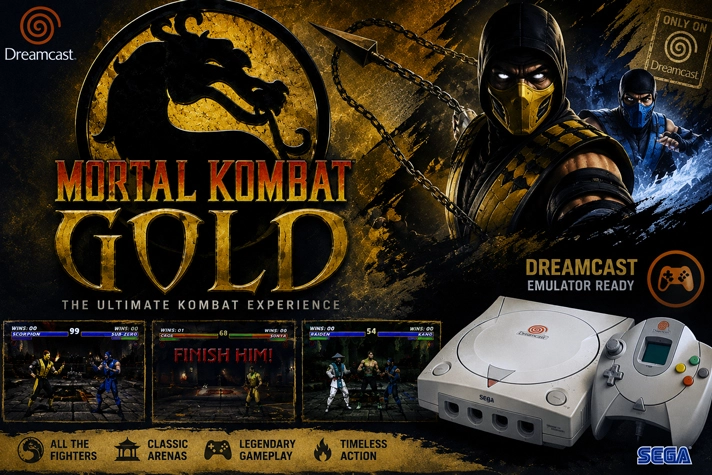
Older rivals inside Mortal Kombat 4
Several names missing from MK4 return in Gold. Kitana uses her fans again, and Mileena returns with sais. Cyrax scatters bombs across the floor. Sektor relies on missiles. Kung Lao’s hat and Baraka’s arm blades make their fighting styles recognizable before either character lands a Fatality. Players coming from Mortal Kombat Trilogy will know these faces, but their attacks now operate within MK4’s sidesteps and weapon system.
The Church, Soul Chamber, Netherrealm, and Ladder are new to Gold. The main conflict still belongs to Shinnok and Quan Chi. Gold does not create a separate campaign for the returning cast.
A Dreamcast fighter for passing the controller
Tournament mode can organize four or eight participants, even though each fight remains one-on-one. That creates a natural pass-the-controller setup: one match ends, the next two names move into place, and the bracket continues. Team mode lets each side choose several characters. Endurance replaces the bracket with a run of opponents that continues until the player is defeated.
A long special-move command is a bad place to discover that one button was mapped incorrectly. Practice mode displays every direction and button being read by the game. The input display separates a missed direction from a bad button assignment before starting a tournament or Endurance run.
Run and Block have their own controls alongside the four attack buttons. Map both to buttons your fingers already rest on. Weapon draws and finishing commands already require enough attention; the controller layout should not become another opponent.